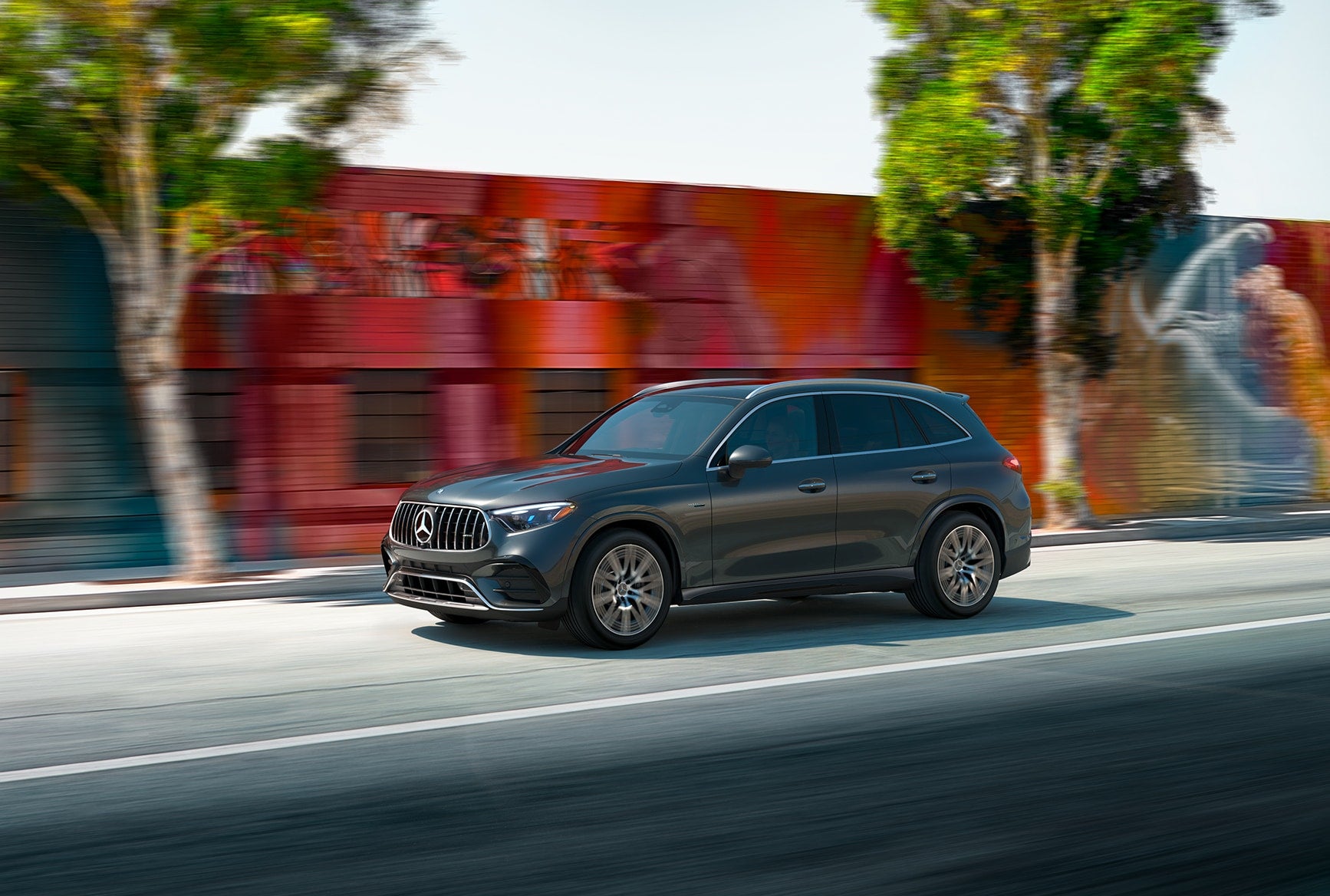

Every Mercedes-Benz SUV shopper walking onto the Loeber Motors lot this fall eventually narrows the field to a version of the same question: the GLC that handles like the sedan it's built alongside, or the GLE that has the room a growing family or a loaded trunk actually needs. Both wear the three-pointed star. Both get 4MATIC® all-wheel drive. The difference comes down to scale. Check Out: Latest Mercedes GLC Inventory The GLC rides on a 113.1-inch wheelbase and stretches 185.7 inches overall, numbers that make it easy to park in a North Shore garage built decades before SUVs this size were common. Cargo space runs 21.9 cubic feet behind the rear seats, expanding to 56.3 cubic feet with those seats folded down. That's enough for a Costco run or a weekend bag for two, and for buyers whose SUV mostly handles the Edens Expressway commute and the occasional Fox River Valley day trip, it's rarely a limiting number. The GLE steps up in every dimension that matters to a bigger household. Its wheelbase runs to roughly 117.9 inches, and overall length reaches close to 194 inches, nearly a foot longer than the GLC. Cargo space starts at 22.25 cubic feet behind the standard second row, climbs to 29 cubic feet with the optional power-adjustable second row, and reaches 72.6 cubic feet with that row folded flat. For a family loading up for a Door County weekend or hauling gear for a season of youth sports out of a North Shore driveway, that difference between 56.3 and 72.6 cubic feet is the one that actually decides a purchase. Both SUVs get the new Mercedes-Benz Operating System, MB.OS, for 2027, which brings a faster, more capable version of MBUX to either dashboard along with an AI voice assistant that learns a driver's habits over time. Neither model gives up anything on the technology side to the other; the GLC's third-generation MBUX and the GLE's MB.OS run on comparably modern hardware, so a buyer choosing the smaller SUV isn't settling for an older infotainment experience. Read More: Why a Certified Pre-Owned Mercedes-Benz EQS Makes Perfect Sense in Chicagoland Where the two diverge again is in what's underneath. The GLC's core engine lineup centers on the GLC 300's turbocharged four-cylinder, tuned for the kind of daily efficiency that matters on a car doing five days a week of Chicagoland commuting. The GLE, particularly in its new AMG GLE 53e HYBRID form, brings a 3.0-liter turbocharged inline-six paired with an electric motor for a combined 577 horsepower and 553 lb-ft of torque, enough for a 4.4-second run to 60 mph in a vehicle that can also carry seven passengers when the optional third row is specified. That's a genuinely different kind of SUV than the GLC is trying to be, built for buyers who want a three-row family hauler that still drives like something with a Mercedes-AMG badge on it. 4MATIC® ties both SUVs together in a way that matters more once the Chicagoland forest preserves start losing their leaves. The system has been a core part of Mercedes-Benz engineering for more than 120 years, refined continuously since the 4MATIC® name itself arrived in 1985, and it stays continuously engaged rather than waiting for a wheel to slip before sending torque where it's needed. On both the GLC and GLE, 4MATIC® integrates directly with the standard Electronic Stability Program for what Mercedes-Benz describes as maximum effectiveness in corners and slippery conditions, though the system can't overcome the basic physics of standard all-season tires on packed snow. Mercedes-Benz is explicit on that point in its own published guidance: best performance in snow is obtained with winter tires, a detail Loeber Motors walks every 4MATIC® buyer through regardless of which body style they choose. Towing capability separates the two further for buyers heading toward a North Shore marina or up to a lake house for the season. The GLE's larger frame and available towing packages put real boat-and-trailer capability within reach in a way the GLC, built on a smaller platform, generally isn't intended to match. For a buyer who never tows anything heavier than a bike rack, that difference rarely factors into the decision at all. What ultimately separates a GLC buyer from a GLE buyer isn't badge snobbery or price alone, it's how much SUV a household actually needs to live with every day. Buyers commuting alone or as a couple, parking in tighter North Shore or Glencoe garages, and rarely filling the cargo area past a weekend's worth of luggage tend to find the GLC does everything they need without the extra length. Buyers hauling kids, gear, and the accumulated cargo of a full family life, particularly those eyeing the GLE's available third row, find the extra foot of length pays for itself the first time they need it. Loeber Motors keeps both SUVs on the lot specifically so that comparison happens behind the wheel rather than on a spec sheet, since a fifteen-minute back-to-back test drive tends to answer the size question faster than any cargo number can. Quick Answers Cargo Space (GLC): 21.9 cu ft behind rear seats / 56.3 cu ft folded Cargo Space (GLE): 22.25–29 cu ft behind rear seats / 72.6 cu ft folded Wheelbase: GLC 113.1 in / GLE approx. 117.9 in Overall Length: GLC 185.7 in / GLE approx. 194 in All-Wheel Drive: 4MATIC® standard across both lineups Frequently Asked Questions What's the main difference between the GLC and GLE? Size and capability. The GLE is nearly a foot longer than the GLC, with significantly more cargo room, an available third row, and stronger towing capability, while the GLC offers a more compact footprint for easier parking and daily driving. Does the GLE offer a third row of seating? Yes, an optional third row is available on the GLE, expanding seating from five to seven, something the GLC's smaller platform doesn't offer. Is 4MATIC® all-wheel drive standard on both SUVs? 4MATIC® is available across the GLC and GLE lineups and integrates with the standard Electronic Stability Program. Mercedes-Benz recommends winter tires for the best performance in snow and ice regardless of trim. Which SUV is better for towing? The GLE generally offers stronger towing capability thanks to its larger platform and available towing packages, making it the better choice for buyers hauling a boat or trailer. Do the GLC and GLE share the same technology? Both get the new Mercedes-Benz Operating System (MB.OS) for 2027, with comparably modern MBUX infotainment and AI voice assistant capability across either model. Expert Summary Choosing between the Mercedes-Benz GLC and GLE comes down to how much SUV a household genuinely needs, not which one carries more prestige. Both share 4MATIC® all-wheel drive and the new MB.OS infotainment platform for 2027, so neither buyer is settling for less technology. The real split is cargo room, seating, and towing: the GLC's tighter footprint suits daily Chicagoland driving and easier parking, while the GLE's extra length, available third row, and stronger towing capability serve families and buyers who regularly load the SUV to its limits. Loeber Motors keeps both on the lot specifically so that decision can be made behind the wheel.